Run With Me Seoul · the app
One number on your phone for whether to run in Seoul right now.
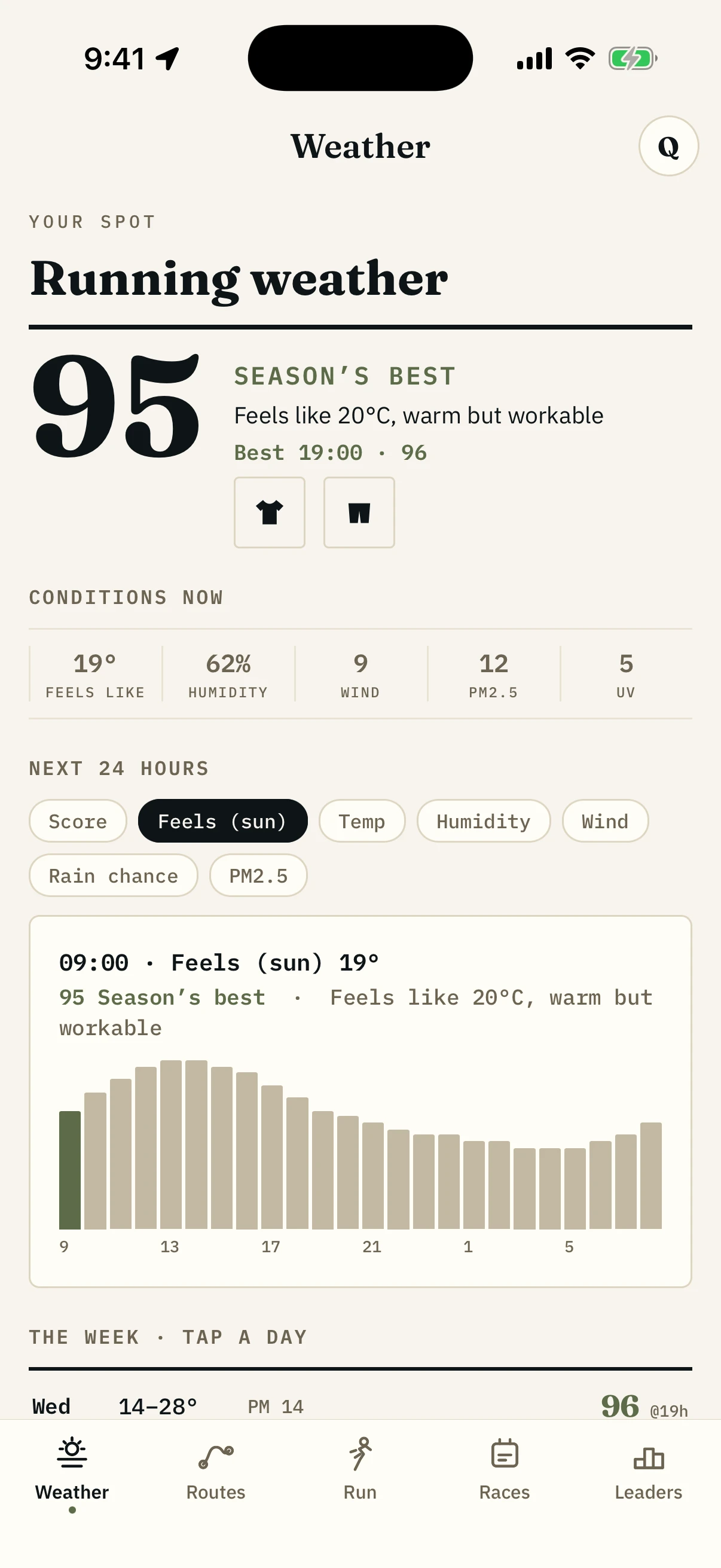
The running weather score in the Run With Me Seoul app turns Seoul's temperature, humidity, rain, wind, sun and PM2.5 into one number from 0 to 100, for the hour you are looking at and the week ahead. It answers the question you were opening four apps for, for you rather than an average person.
Free. iOS and Android.
- 0-100
- one number for the hour you are looking at
- Four apps
- you can stop opening every morning
- 7 days
- ahead, with the best window marked
How the score works.
01
Open it and get the number.
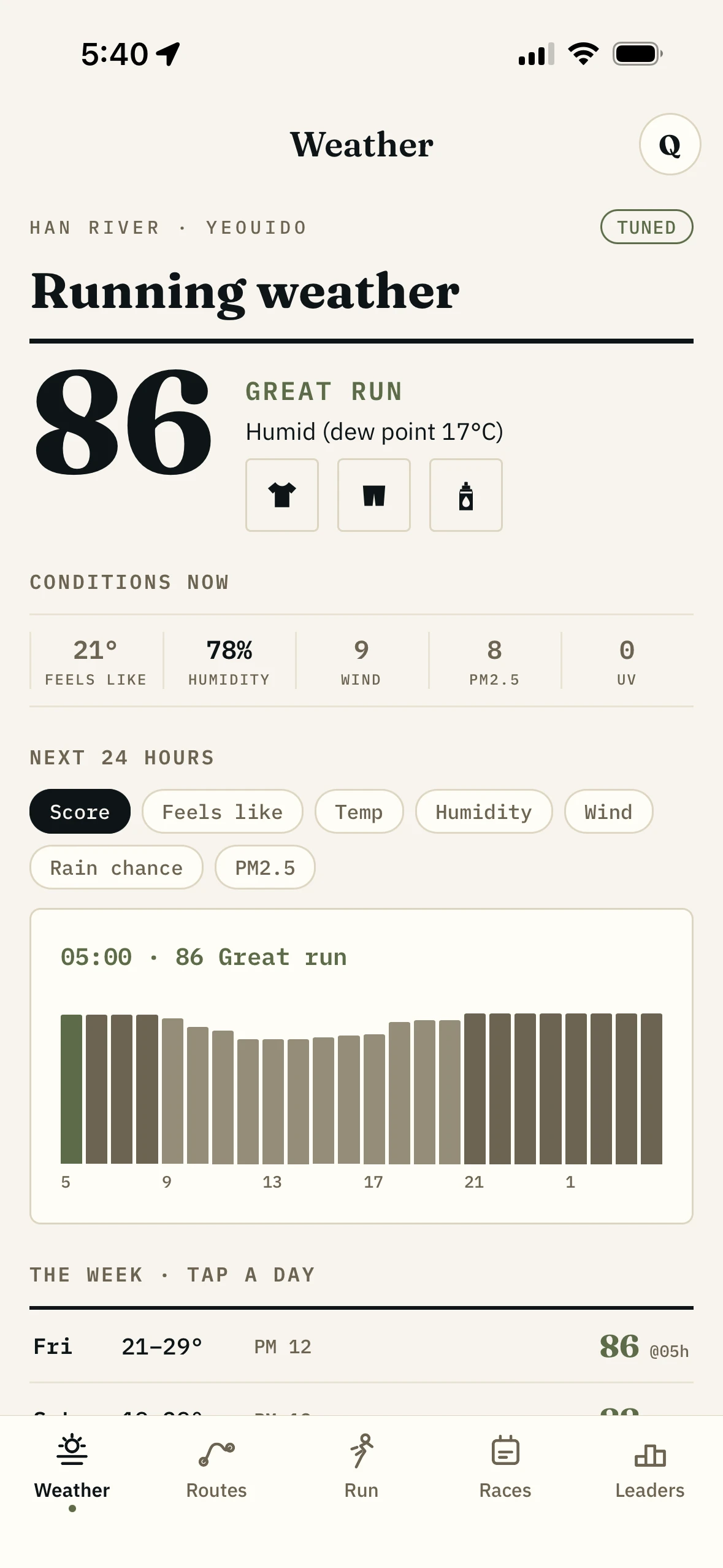
A score out of 100 for right now, where you are, with the verdict in words and the reasons underneath. On iPhone it sits on your home screen as a widget, so most mornings you never open the app at all.
02
It scores the heat you will actually feel.
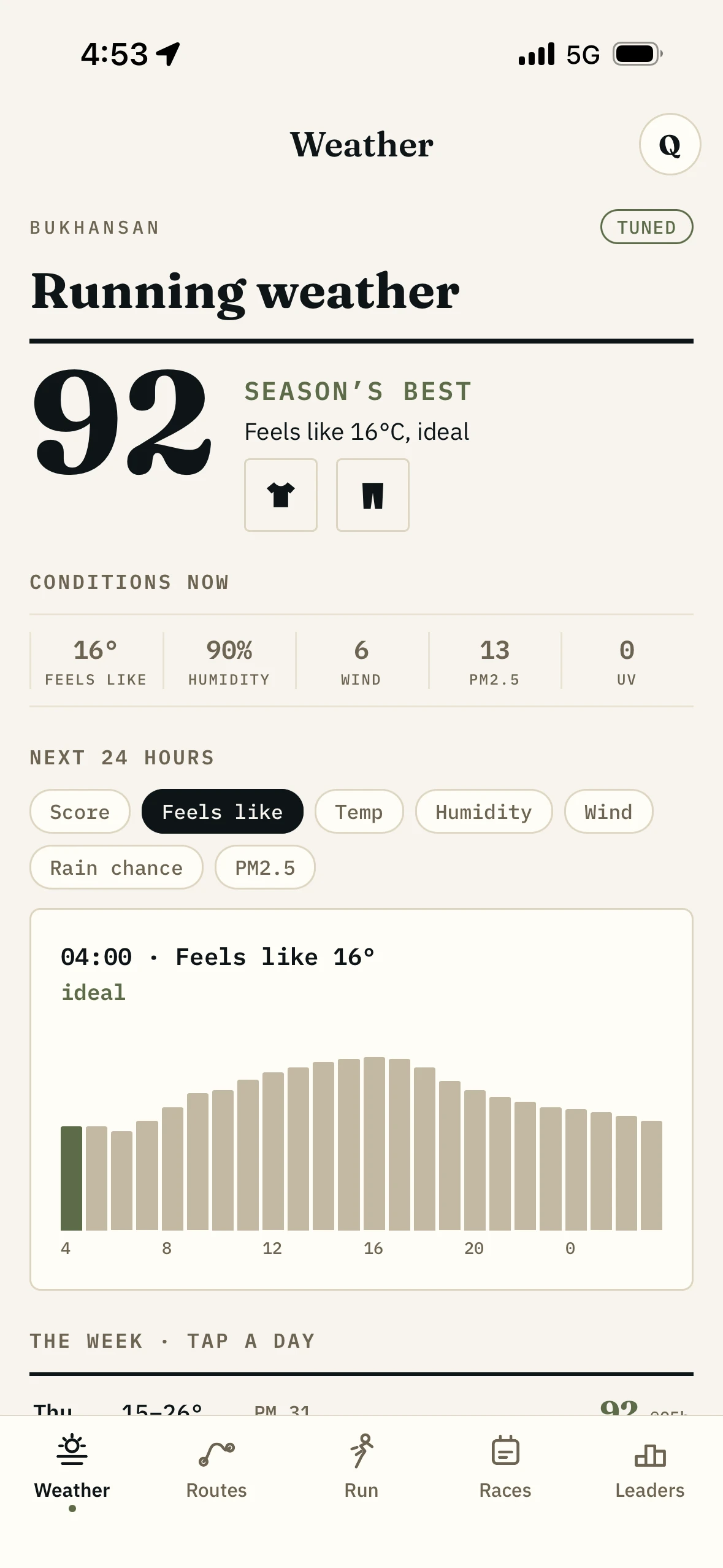
Above 20°C the score switches to the shade heat index rather than the solar-loaded feels-like every weather app shows you. Those run 4 to 8 degrees apart on a sunny day, and the Han path has no shade.
03
Look ahead and find the window.
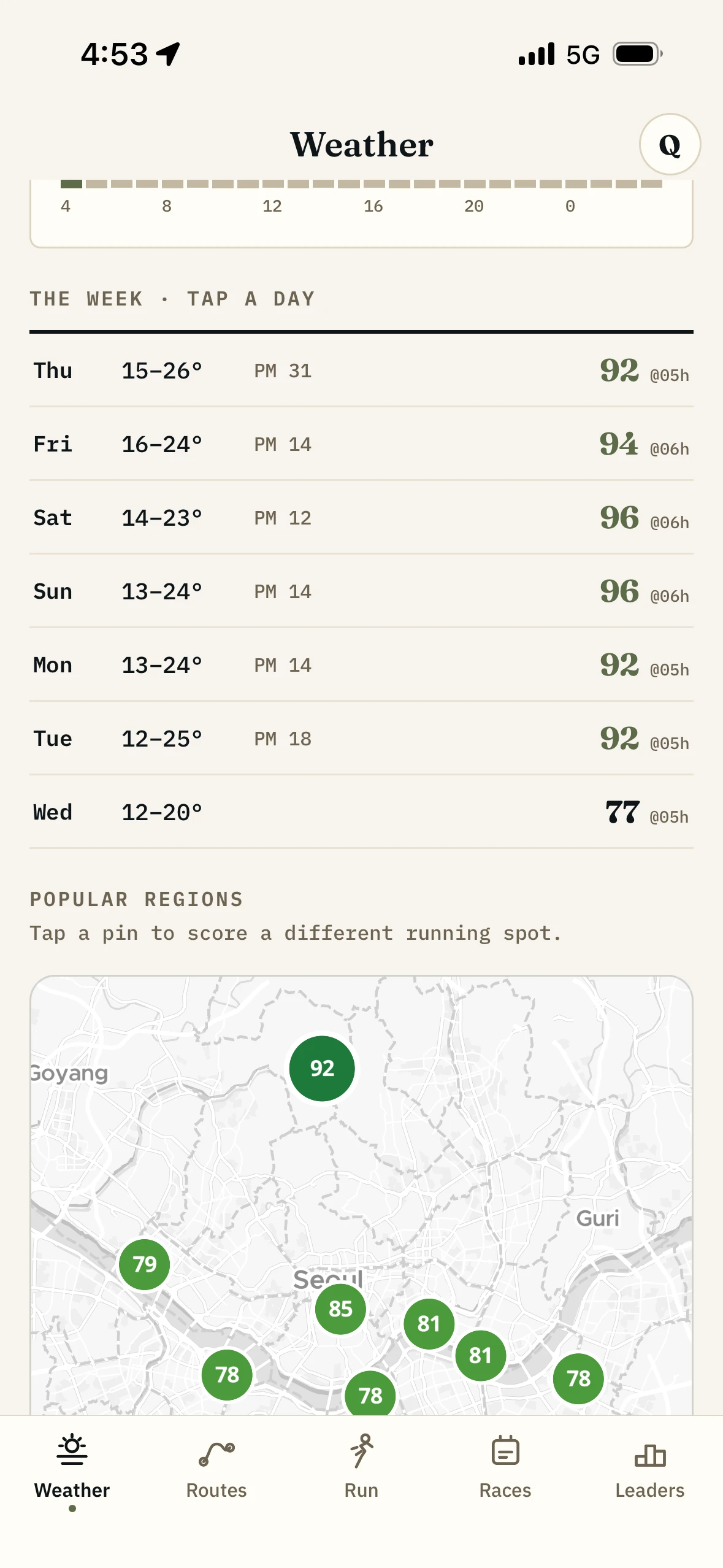
An hourly chart with the best three-hour window marked, and a week of days behind it. This is how a long run moves from Friday to Thursday before you commit to Friday.
04
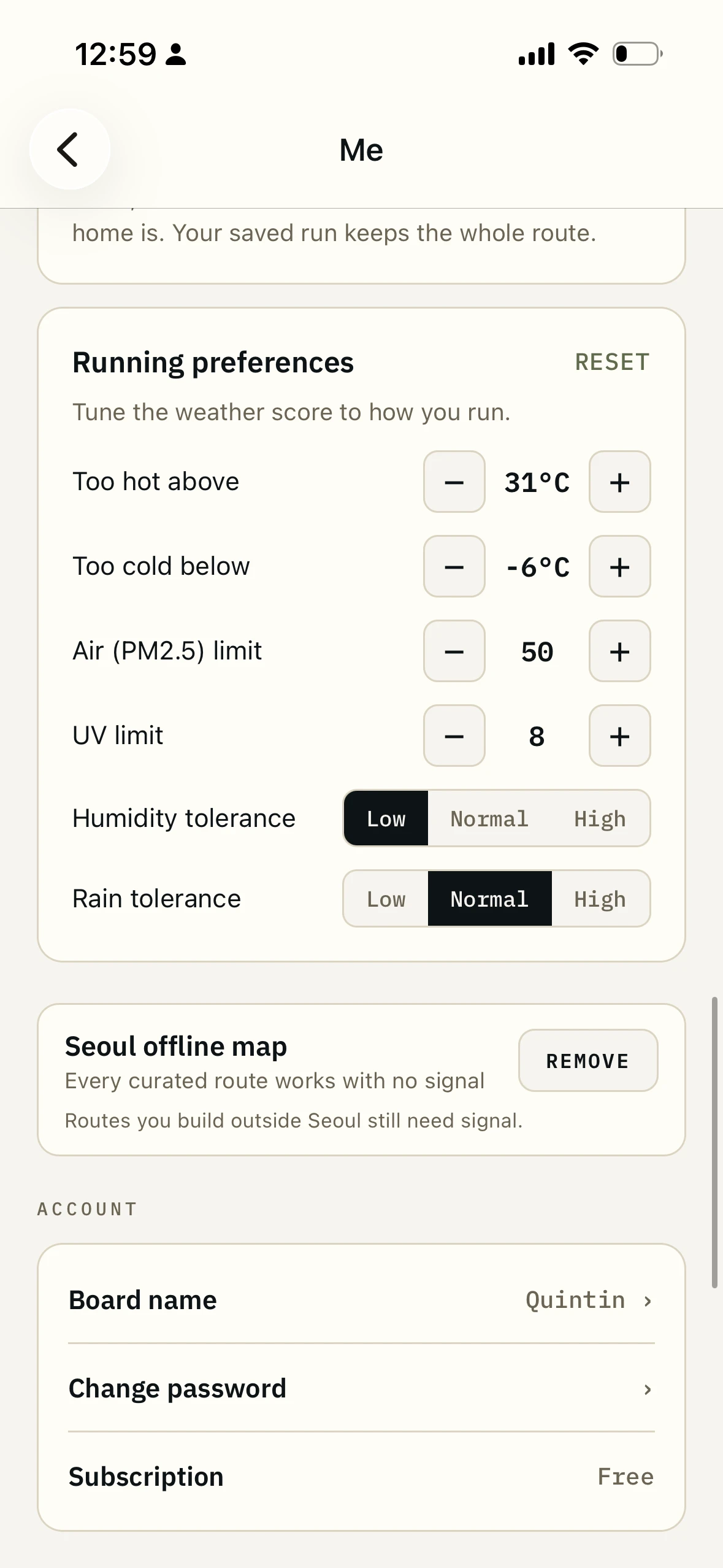
Tell it what you can stand.
Set the heat and cold you bail at, the PM2.5 you will not run in, and how much humidity and rain you tolerate. The score then describes your run, not an average person's.
What goes into the score.
- The score
- 0 to 100, with a verdict in words and the reasons that produced it
- What it weighs
- Temperature 30%, rain 25%, air 23%, wind 13%, UV 9%, with humidity subtracted on top
- Heat
- Shade heat index above 20°C, not the solar feels-like that runs 4 to 8°C hotter
- Season
- Graded against what that week in Seoul can offer, so August is not permanently a 20
- Air now
- Ground stations, including the Korean AirKorea network
- Air later
- A forecast model, 2.9x lower error than the station composite at three days out across 544 paired days of my own archive
- Hard limits
- Bad air, high wind and Asian dust cap the score no matter how good everything else is
- Missing data
- No score at all rather than a flattering guess
- Ahead
- Hourly with the best window marked, and seven days
- Price
- Free
What the score is made of.
Why the air number for today and the air number for Thursday come from different places.
Who it is for.
You are going out either way and want to know what you are in for.
That is me. I run at -12 and I run in August. The point was never permission. The difference between -6 and -12 is gloves, and kilometre two is a bad place to learn that.
Your lungs are the deciding factor.
Set the PM2.5 you will not run in and the score respects it. Above the official bad-air line, no setting talks the number up.
You are checking four apps every morning.
Temperature in one, humidity in another, air quality in a third, rain in a fourth, and the combination is what actually decides. That is why this exists.
You are planning the week, not the morning.
The long run wants the best day of the seven. A week of scores tells you it is Thursday before you talk yourself into Friday.
What it is not.
The running weather score is not a weather app.
No radar, no severe-weather alerts, no ten-day outlook, no typhoon tracking. Keep the weather app you have; this one answers a narrower question.
It is not a forecast service.
The numbers come from Open-Meteo and from air-quality stations. What is mine is the scoring: which factors matter to a runner and how much. Bad input makes a bad score and I cannot fix the sky.
It is not medical advice.
It has no idea about your asthma, your medication or your heart. It describes the air and the heat. What you do about that is between you and someone with a licence.
It is not the version to read.
How the score is built, what PM2.5 does to a runner and why the two feels-like numbers disagree are on this site. The app is the number in your hand.
How it fits with the rest of the app.
- Today's score on the web
The same scoring, live, with no install. The app adds your location, your tolerances, the week ahead and the home-screen widget.
- Seoul air quality for runners
The long version of the air argument: what the numbers mean, which source to believe, and when Seoul is actually bad.
- Curated Seoul routes
A hot day is a shade question as much as a temperature one, and these routes differ enormously on shade.
Questions.
What goes into the score?
Temperature 30%, rain 25%, air quality 23%, wind 13%, UV 9%, then humidity comes off the top as a dew-point penalty. Bad air, high wind and Asian dust each cap the number, so a perfect 18 degrees cannot rescue a day the air has ruined.
Why does your feels-like disagree with my weather app?
Most apps show an apparent temperature that includes sunlight, which runs 4 to 8 degrees above the shade equivalent on a clear day. Above 20 degrees this score uses the shade heat index instead. Neither is wrong; a runner on an unshaded riverside path is asking the second question.
Why not use the station reading for the forecast too?
Because I measured it. Across 544 paired days of my own archive, the model was out by 7.6 µg/m³ at three days ahead and the station composite by 21.7. The app uses each source where it wins.
Can I set it to ignore bad air?
Only up to a point. Inside the good and moderate bands your tolerance applies in full. Once the real reading is into the bad band, raising it stops buying you a better number, though lowering it still works. The official threshold is not a preference.
What happens when a number is missing?
You get no score rather than a comforting one. An earlier version defaulted missing inputs toward "fine" and produced an 89 out of clean air and nothing else. Absence read as good news, so now it refuses.
How far ahead does it go?
Seven days of weather, hourly at the near end, with the best window marked. Air quality reaches five days, and past that the app says so rather than guessing.
Stop opening four apps.
The running weather score, on your home screen, free, on iOS and Android.
The rest of the app.
- Curated Seoul routes64 routes, offline, turn by turn
- The route builderDraw a line, it snaps to runner paths
- Water, toilets and stores7,274 places on the map, no signal needed
- GPS run trackingRecords offline, follows your route, GPX in and out
- Leaderboards and friendsWhole routes, not segments, among people you know
- The Korea race calendar400+ races, with an alarm before entries open